

- Home
- Multimodal Transportation in Nepal: Why It Matters for a Landlocked Country
Multimodal Transportation in Nepal: Why It Matters for a Landlocked Country
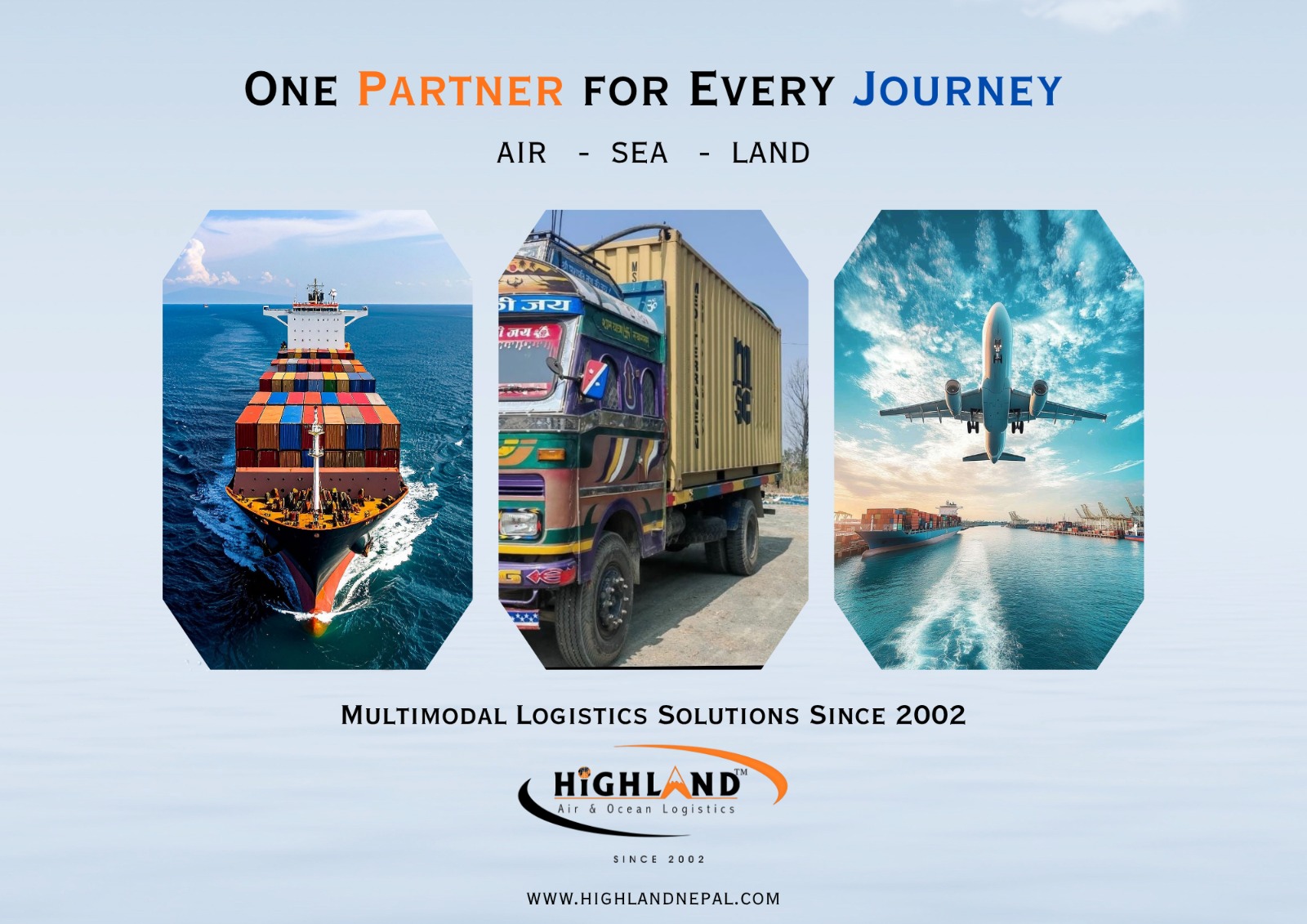
International cargo rarely travels from origin to destination using just one mode of transportation.
A shipment may begin its journey by truck, continue by rail, cross the ocean aboard a container vessel, and finally move by road again before reaching its destination. Coordinating these different stages is what makes multimodal transportation an important part of modern international logistics.
For Nepal, this is particularly significant.
As a landlocked country, Nepal depends on transportation networks beyond its borders to connect with international markets. Cargo moving to and from Nepal may involve roads, inland facilities, border crossings, rail networks, international airports, and seaports in neighboring countries.
The efficiency of these connections can have a direct impact on transportation costs, delivery times, and the overall reliability of international trade.
What is Multimodal Transportation?
Multimodal transportation is the movement of cargo using two or more modes of transport as part of a coordinated journey from origin to destination.
These modes can include:
- Road
- Rail
- Ocean
- Air
For example, a shipment from Nepal to Europe could move by road from the supplier to an inland facility, continue by road or rail toward an international gateway port, travel by ocean to Europe, and then move by road or rail to the final consignee.
Each mode has a different role, but the objective remains the same: to move the cargo efficiently from origin to destination.

Why Does Nepal Need Multimodal Transportation?
Nepal’s geography makes international logistics different from that of a coastal country.
Without direct access to the sea, Nepal’s international maritime trade relies on connections with ports outside the country. This means that cargo must move through a combination of domestic and international transportation networks before reaching global shipping routes.
A typical shipment may involve:
Origin → Road Transport → Border / Inland Facility → Rail or Road → Seaport → Ocean Freight → Destination Port → Final Delivery
Every connection matters.
A delay at a border, terminal, port, or transfer point can affect the schedule of the entire shipment. This makes coordination just as important as the individual transportation modes themselves.
How Different Transport Modes Work Together
Road Transportation
Road transport provides flexibility and connects factories, warehouses, customs points, inland facilities, airports, and border crossings.
For many Nepalese shipments, road transportation forms the first or final connection in a larger international journey.
Rail Transportation
Rail can provide an efficient option for inland movement of containerized cargo, particularly when moving larger volumes over longer distances.
For Nepal’s third-country trade, rail connections through India can form part of the journey between inland cargo facilities and international gateway ports.
Ocean Transportation
Ocean freight connects Nepal’s international cargo with global shipping networks through regional seaports.
It is generally suitable for larger volumes, containerized cargo, and shipments where transit time is less critical than overall transportation cost.
Air Transportation
Air freight provides a faster alternative when time is a priority.
It can be suitable for urgent shipments, high-value cargo, critical spare parts, samples, and other goods where shorter transit times justify the higher transportation cost.
The choice between these modes depends on the cargo, destination, urgency, budget, and required delivery schedule.

The Importance of Coordination
Using several transportation modes is only part of the challenge.
The real challenge is connecting them effectively.
A shipment may need to meet a particular vessel schedule, complete customs procedures, arrive at a terminal within a specified window, or transfer between road and rail without unnecessary storage or handling.
Documentation must also remain consistent throughout the journey.
This is why multimodal transportation requires careful planning and coordination.
A logistics provider needs to consider:
- Transit time
- Total transportation cost
- Cargo characteristics
- Customs and documentation
- Available infrastructure
- Border and terminal conditions
- Connection schedules
- Potential risks and delays
The cheapest individual transportation option does not necessarily create the most cost-effective overall solution.
A route that saves on freight but adds several days of transit, additional handling, or storage costs may ultimately be more expensive.
Multimodal Transportation and Nepal’s International Trade
For businesses importing into or exporting from Nepal, logistics is an important part of overall competitiveness.
A shipment does not become economical simply because its main freight rate is low. Businesses also need to consider transit time, handling, customs procedures, storage, reliability, and the possibility of delays.
A well-planned multimodal solution balances these factors.
For example, a large non-urgent shipment may be better suited to an ocean-based solution, while an urgent shipment may justify air freight. Another shipment may require a combination of road, rail, and ocean transportation to achieve the right balance between cost and transit time.
There is therefore no single route that is best for every shipment.
The right solution depends on the requirements of the cargo and the business.
The Role of Freight Forwarding
This is where freight forwarding and multimodal transportation come together.
A freight forwarder coordinates the different elements of a shipment, working with carriers, transport providers, customs authorities, overseas agents, and other logistics partners.
The role can include:
- Route planning
- Carrier coordination
- Inland transportation
- Documentation
- Customs coordination
- Cargo consolidation
- Shipment monitoring
- Transfer between transport modes
- Final delivery arrangements
The objective is to turn several individual transportation legs into one coordinated logistics solution.
For Nepalese importers and exporters, this coordination can be particularly valuable because international shipments may cross multiple borders and transportation systems before reaching their final destination.
Turning Nepal’s Geography into Global Connectivity
Being landlocked does not mean being disconnected from global trade.
It means that connectivity must be carefully planned.
Nepal’s international supply chains depend on the ability to connect domestic transportation networks with regional gateways and global shipping routes. Roads, railways, inland facilities, border points, airports, and seaports each form part of a larger logistics network.
The objective of multimodal transportation is not simply to use multiple modes.
It is to select and coordinate the right combination of modes based on cost, time, cargo requirements, reliability, and risk.
For Nepal, effective multimodal transportation is therefore more than a logistics strategy. It is an important connection between Nepalese businesses and the global marketplace.
